
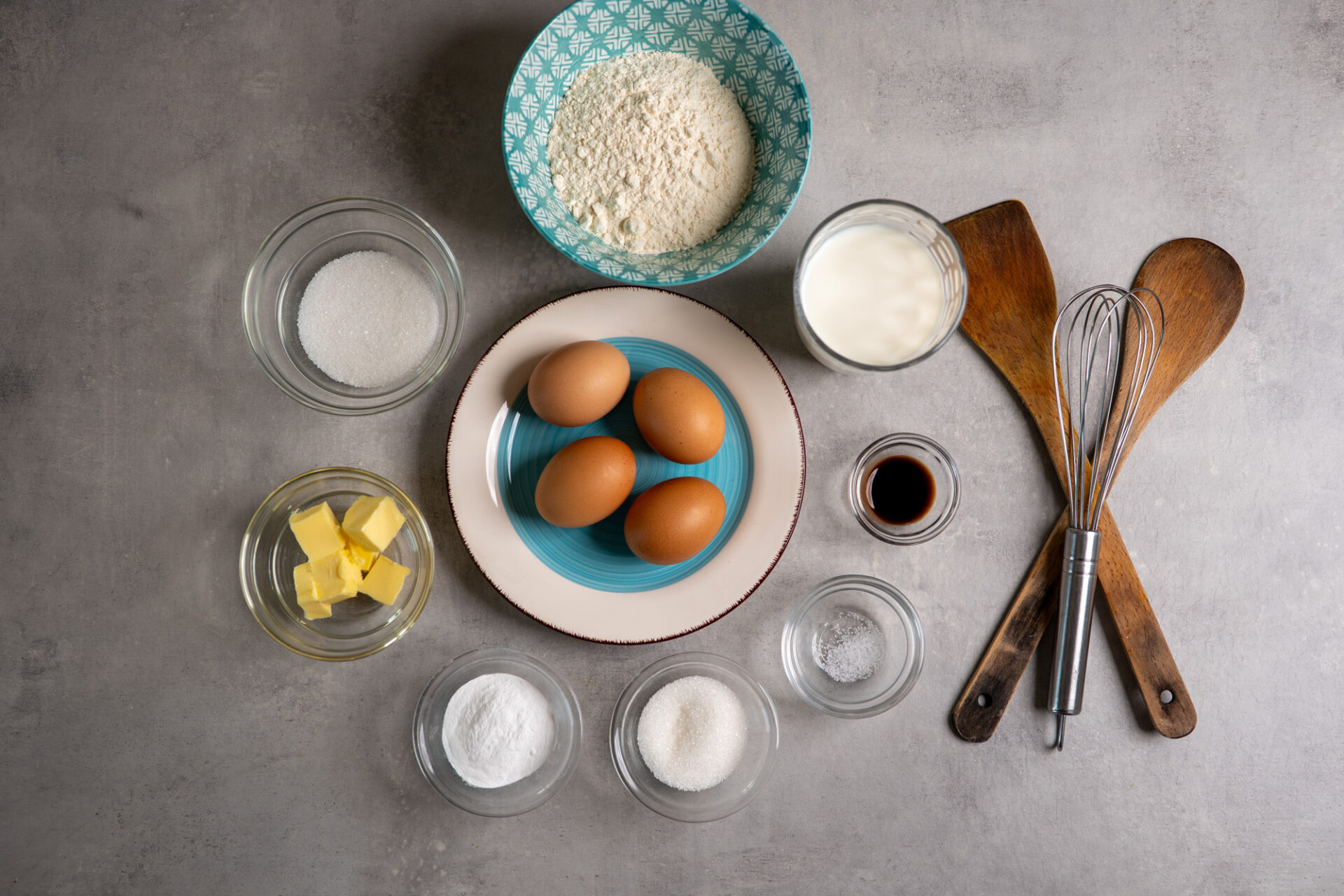
Almost every recipe on this site is written in grams, because that is how Austria bakes — and almost half of you are reading from the United States, where the kitchen runs on cups. This page is the bridge. Type your amount into the converter, or scroll for the charts, the oven settings, the tin sizes, and the section nobody else covers: how to read an Austrian or German recipe when it says 25 dag Mehl, 1 Würfel Germ, 2 EL Zucker.
Grams to cups converter
1. Ingredient: grams ⇄ cups
2. Liquids: ml ⇄ cups
3. Oven: °C ⇄ °F (with fan setting and gas mark)
4. Austrian & German recipe units
Cup values are spoon-and-level US cups (240 ml) and are approximate: ±5% is normal. For baking, a €10 digital scale beats every chart on this page.
How many grams are in a cup?
It depends entirely on the ingredient. A US cup is a volume (240 ml), and a cup of flour weighs about 125 g while a cup of sugar weighs 200 g and a cup of butter 227 g. That is why a recipe converted with one blanket number goes wrong, and why every serious baker in Europe uses a scale. The converter below uses ingredient-specific weights, spoon-and-level, so the answer is as close as cups can get.
Grams to cups chart for the most common baking ingredients
Spoon the ingredient into the cup and level it with a knife — do not scoop and pack, which can add 20% to flour. Values are rounded; a few grams either way will not hurt a cake, but it can hurt bread.
| Ingredient | 1 cup | ½ cup | ¼ cup | 1 tbsp |
|---|---|---|---|---|
| All-purpose / plain flour | 125 g | 63 g | 31 g | 8 g |
| Granulated sugar (Kristallzucker) | 200 g | 100 g | 50 g | 13 g |
| Powdered / icing sugar (Staubzucker) | 120 g | 60 g | 30 g | 8 g |
| Brown sugar, packed | 220 g | 110 g | 55 g | 14 g |
| Butter | 227 g | 113 g | 57 g | 14 g |
| Cocoa powder | 85 g | 43 g | 21 g | 5 g |
| Ground almonds / hazelnuts / walnuts | 100 g | 50 g | 25 g | 6 g |
| Fine dry breadcrumbs (Semmelbrösel) | 110 g | 55 g | 28 g | 7 g |
| Rolled oats | 90 g | 45 g | 23 g | 6 g |
| Semolina (Grieß) | 170 g | 85 g | 43 g | 11 g |
| Cornstarch | 128 g | 64 g | 32 g | 8 g |
| Poppy seeds, ground | 140 g | 70 g | 35 g | 9 g |
| Raisins | 150 g | 75 g | 38 g | 9 g |
| Honey | 340 g | 170 g | 85 g | 21 g |
| Jam / Powidl | 320 g | 160 g | 80 g | 20 g |
| Quark / Topfen | 240 g | 120 g | 60 g | 15 g |
Ground nuts are the ones to watch: a cup of ground hazelnuts for Esterházy torte weighs almost half what a cup of sugar does, and nut-based Austrian cakes are unforgiving about it.
Liquids: millilitres to cups and fluid ounces
| Millilitres | US cups | US fl oz | Tablespoons |
|---|---|---|---|
| 60 ml | ¼ cup | 2 fl oz | 4 tbsp |
| 80 ml | ⅓ cup | 2.7 fl oz | 5⅓ tbsp |
| 120 ml | ½ cup | 4 fl oz | 8 tbsp |
| 180 ml | ¾ cup | 6 fl oz | 12 tbsp |
| 240 ml | 1 cup | 8 fl oz | 16 tbsp |
| 250 ml | 1 cup + 2 tsp | 8.5 fl oz | 16⅔ tbsp |
| 500 ml | 2 cups + 4 tsp | 17 fl oz | 33⅓ tbsp |
| 1 litre | 4¼ cups | 34 fl oz | 67 tbsp |
Note the 250 ml trap: a European recipe’s “250 ml milk” (like the batter in my Kaiserschmarrn) is a cup plus a splash. In a pancake batter nobody will notice; in a custard you will.
How to read an Austrian or German recipe: dag, EL, TL, Würfel Germ and friends
This is the part the converter sites skip. Austrian recipes — cookbooks, grandmothers, the butcher — use a handful of units and abbreviations that make no sense in English. Here is the decoder.
| You will see | It means | In practice |
|---|---|---|
| dag / Deka / dkg | Dekagramm = 10 g | 25 dag flour = 250 g. Austrians shop in Deka: “10 Deka Schinken” is 100 g of ham. German recipes rarely use it; Austrian ones use it constantly. |
| EL | Esslöffel = tablespoon | Level EL ≈ 15 ml. Austrian cooks mean a heaped spoon unless told otherwise: a heaped EL of flour is about 20 g, of sugar about 15 g. |
| TL | Teelöffel = teaspoon | ≈ 5 ml. Heaped TL of baking powder ≈ 5 g. |
| 1 Würfel Germ (Austria) / Hefe (Germany) | One cube of fresh yeast | 42 g fresh yeast — the standard supermarket cube in Austria and Germany. See the yeast table below. |
| 1 Packerl / Päckchen Trockengerm | One sachet of dry yeast | 7 g dry yeast = half a Würfel of fresh. |
| 1 Packerl Vanillezucker | One sachet of vanilla sugar | 8 g. Substitute 1 tsp vanilla extract plus 1½ tsp sugar. |
| 1 Packerl Backpulver | One sachet of baking powder | About 15 g ≈ 1 tbsp, meant for 500 g flour. |
| Prise | Pinch | What you pick up between thumb and finger. |
| Messerspitze (Msp.) | Knife tip | Less than a pinch — about ⅛ tsp. Used for spices and salt. |
| Schuss | A dash / splash | Of rum, of milk. Roughly 1–2 tbsp; nobody measures it. |
| Staubzucker / Puderzucker | Powdered (icing) sugar | Austria says Staub-, Germany says Puder-. Same thing. |
| Kristallzucker / Feinkristallzucker | Granulated / fine granulated sugar | Austrian “fine crystal” sugar is a touch finer than US granulated; interchangeable. |
| Mehl glatt / griffig / universal | Smooth / coarse / all-purpose flour | Austrian flour grades. Glatt for cakes and pastry, griffig for dumplings and strudel (it absorbs slowly), universal when you have only one bag. US all-purpose stands in for all three. |
| Obers / Schlagobers | Cream / whipping cream | Austrian words; Germany says Sahne. |
| Topfen / Quark | Fresh curd cheese | Austrian / German names for the same thing. Nearest substitutes: Greek yogurt strained overnight, or ricotta blended smooth. |
| Marillen / Zwetschken / Ribisel | Apricots / prune plums / redcurrants | Austrian fruit words that baffle even Germans. My Powidl is made from Zwetschken. |
Fresh yeast to dry yeast conversion
Central European recipes assume fresh yeast; most of the world has sachets. The rule of thumb: fresh yeast × 0.5 = active dry yeast; fresh yeast × 0.33 = instant yeast. For rich, sweet doughs like Buchteln I lean towards 0.4 for instant, because butter and sugar slow the yeast down.
| Fresh yeast (Germ / Hefe) | Active dry yeast | Instant yeast | Sachets (7 g) |
|---|---|---|---|
| 10 g | 5 g | 3–4 g | ½ |
| 21 g (½ Würfel) | 10 g | 7 g | 1 |
| 42 g (1 Würfel) | 21 g | 14 g | 2 |
| 50 g | 25 g | 17 g | 2½ |
Oven temperatures: conventional, fan, Fahrenheit and gas mark
Austrian recipes give conventional (top-and-bottom heat) temperatures unless they say Umluft or Heißluft, which is fan. Fan ovens run about 20 °C hotter in effect, so drop the number.
| Conventional °C | Fan / Umluft °C | °F | Gas mark | Typical use |
|---|---|---|---|---|
| 140 | 120 | 275 | 1 | Meringue, slow drying, Powidl |
| 160 | 140 | 325 | 3 | Rich yeast cakes, Gugelhupf |
| 180 | 160 | 350 | 4 | Most cakes, Buchteln, banana bread |
| 200 | 180 | 400 | 6 | Strudel, Kaisersemmel, puff pastry |
| 220 | 200 | 425 | 7 | Bread crust, first minutes of rolls |
| 240 | 220 | 475 | 9 | Pizza, hot start for bread |
Cake tin sizes: centimetres to inches
A 24 cm Austrian springform is a 9½-inch tin: use a 9-inch and bake a few minutes longer, or a 10-inch and check early. The Gugelhupf form is the exception — a 22–24 cm ring mould holds about 2 litres, roughly a 10-cup bundt pan.
| European tin | Nearest US tin | Volume (approx.) |
|---|---|---|
| 18 cm round | 7-inch | 1.2 L |
| 20 cm round | 8-inch | 1.5 L |
| 22 cm round | 8½-inch | 1.8 L |
| 24 cm round | 9½-inch (use 9 or 10) | 2.2 L |
| 26 cm round | 10-inch | 2.6 L |
| 28 cm round | 11-inch | 3 L |
| 30 × 20 cm rectangular | 9 × 13-inch (slightly larger) | 3 L |
| Gugelhupf 22–24 cm | 10-cup bundt | 2–2.4 L |
Egg sizes: Europe versus the USA
European egg sizes are by weight in the shell: M = 53–63 g, L = 63–73 g. A US large egg is about 57 g, which is a European medium. So when an Austrian recipe says “3 Eier (M)” and you have US large, you are fine; if it says L, add a splash of extra egg or use one more for every four. My banana bread uses one large egg and does not care; a soufflé does.
Frequently Asked Questions
Why does my American cup give different results than the recipe?
Because two people measuring a cup of flour can differ by 30 g depending on scooping, packing and humidity. Grams are grams. If you bake European recipes more than occasionally, a digital scale costs less than one failed torte’s worth of butter and nuts.
Is a UK cup the same as a US cup?
No. The US cup is 240 ml (legally 236.6); the metric cup used in the UK, Australia and New Zealand is 250 ml; the old imperial cup is 284 ml. The charts on this page use the US cup. Australian readers: your cup is 4% bigger, which matters for flour in bread but not for sugar in a cake.
How do I measure flour by cup correctly?
Fluff the flour in the bag, spoon it into the cup until it mounds, then level with the back of a knife. Never tap the cup or scoop straight from the bag. Done this way, a cup of plain flour lands within a few grams of 125.
How many cups is 100 g?
It depends on what you are measuring. 100 g flour is about ¾ cup plus 1 tablespoon (0.8 cup); 100 g sugar is ½ cup; 100 g butter is 7 tablespoons, just under ½ cup; 100 g icing sugar is a generous ¾ cup. Type the ingredient into the converter above for anything else.
How many cups is 200 g?
200 g flour is about 1½ cups plus 2 tablespoons (1.6 cups); 200 g sugar is exactly 1 cup; 200 g butter is 14 tablespoons, a scant cup (0.9); 200 g ground nuts is 2 cups.
How many cups is 250 g?
The most common amount in Austrian recipes (25 dag). 250 g flour is 2 cups; 250 g sugar is 1¼ cups; 250 g butter is 1 cup plus 1½ tablespoons; 250 g Topfen or quark is just over 1 cup; 250 ml milk is 1 cup plus 2 teaspoons.
What is 1 dag in grams?
10 grams. 5 dag is 50 g, 25 dag is 250 g. It is an Austrian (and Hungarian, Polish and Czech) habit rather than a German one; if a recipe uses it, chances are it is from the old Habsburg lands.
Found this useful? Bookmark it — every recipe on this site links back here, and I add units as readers ask. If a term from an Austrian recipe has you stuck, tell me in the comments and I will decode it and add it to the table.
Did this page save your bake? Bookmark it, and if a unit from an Austrian recipe still has you stuck, tell me in the comments — I answer every single one and add the term to the table.